
Legal departments managing cross-border litigation often struggle when they reach for a handheld translator device to process a 50-page multilingual agreement, only to find the file’s rigid clause structures completely destroyed upon output.
Document Translation Workflow: Why Teams Struggle with Hardware Limits
When legal professionals attempt to use hardware-based translators for document workflows, the disconnect between verbal-processing design and structural-file requirements becomes immediately apparent. Legal assets require more than just word-for-word substitution; they demand precise retention of table formatting, signature blocks, and complex pagination.
| Method | Best Use Case | Security Level | Format Retention | Scalability |
|---|---|---|---|---|
| Handheld Translator Devices | Verbal Hallway Chitchat | Low (Data Leak Risk) | Non-existent | Very Low |
| Browser-based Free Tools | Quick Phrases / Drafts | Zero (No Privacy) | Minimal | Medium |
| Enterprise Document Platforms | Legal Agreements / Evidence | Highest (Encrypted) | Professional / Full | High |
The data above underscores a fundamental technical reality: handheld devices are built for ASR (Automated Speech Recognition) and rapid verbal interpretation, not for parsing the nested XML or structured layout of a high-stakes legal document. Using a device to process a 50-page filing for a foreign jurisdiction results in broken formatting and the loss of source context that legal associates must spend hours manually repairing. Only enterprise platforms provide the structural integrity required to keep contract clauses mapped exactly as they appear in the source files, which is a essential requirement for court filings and evidence schedules.
What Reliable Workflow Design Needs
Security and confidentiality serve as the primary pillars for any legal tool selection, as sensitive client information requires a level of protection that consumer-grade hardware cannot verify or maintain. The designated 'review owner' must evaluate tools strictly on their ability to handle confidential contract clauses and cross-border litigation files without leaking metadata into the public internet or open-source hardware caches.
Legal teams operate under strict mandates regarding the movement and storage of sensitive data. Every time a contract is processed, the system must ensure the encryption of the file throughout the entire translation lifecycle.
Effective translation of high-stakes legal assets depends on several essential performance factors that ensure the final document holds up in a court of law:
- Structural Fidelity: The tool must support direct file uploads (Word, PDF, Excel) and retain all original fonts, margins, and column layouts. * Language Support: Access to over 100 languages is essential for global litigation teams that work across disparate regulatory environments. * Metadata Compliance: The system must operate without storing sensitive personal metadata in ways that violate cross-border data privacy standards. * Terminology Control: The ability to upload custom legal glossaries ensures that specific contract terms remain consistent across the entire evidence schedule.
For the practical workflow, best translator device with Doctranslate.io keeps the source file, target output, and review step in one place.
How Doctranslate.io Reduces Review Cleanup
Handheld translator devices are designed for verbal interaction, which inevitably leads to the total loss of document structure when attempting to process complex, multi-page legal agreements. Legal teams frequently lose hours of billable time performing "cleanup" work, re-inserting missing text or realigning table cells that were garbled by incorrect document processing software.
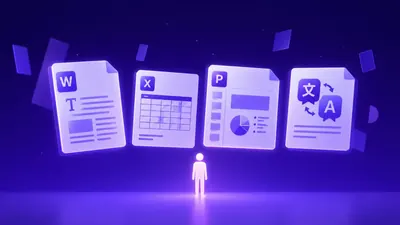
When teams rely on the document translation capabilities of an enterprise platform, the software handles the conversion of native file types like Microsoft Word, PowerPoint, and Excel while preserving the visual and functional integrity of the file. This ensures that when an associate opens a translated evidence schedule, every row, header, and footnote is positioned exactly where the original author intended. By treating the document as a single cohesive unit rather than a collection of scattered text strings, the system eliminates the formatting drift that causes manual labor bottlenecks in firms.
Legal professionals must maintain clear, immutable boundaries for what constitutes a "certified" translation. Portable devices cannot produce the required certification logs or maintain the integrity of a notarized document. Using an enterprise-grade platform allows teams to maintain a digital audit trail, ensuring that the translation process itself conforms to the high standards required for legal documentation.
This transparency provides the "truth" in multilingual agreements, giving legal counsel the confidence that the translated text matches the source legal intent, word for legal word.
Step-By-Step File Translation Process
Legal teams require exact delivery formats that mirror the source layout to maintain 'truth' in multilingual agreements, especially when coordinating evidence schedules and control narratives. The traditional process of reformatting documents manually after a translation tool has failed is an inefficient drain on high-cost associate time.
Automated platforms change the legal workflow by allowing teams to upload complex files that the system then maps to the target-language output while maintaining the original design, font weights, and document markers. This removes the need for legal associates to spend hours correcting broken document layouts or realigning evidence schedules manually.
Platform-based workflows offer detailed audit logs that serve as evidence of process compliance. Every time a legal document is translated, the system records the version, the time, and the language pair involved. This level of oversight is essential for compliance in large-scale litigation, where the provenance of every document must be provable.
Portable translator devices fail this audit test, as they treat every document as a one-off, untracked event, lacking the system-level visibility that legal teams require.
Use Cases by Team and Asset
Terminology mismatches often present the greatest risk to legal compliance during cross-border discovery. When a translator tool uses the wrong regional legal term, it can alter the meaning of a liability clause, rendering the document legally unenforceable or potentially damaging to the client’s case.
Encryption and secure data handling are the only ways to ensure that privileged communication remains confidential throughout the translation process. Enterprise platforms provide the necessary safety layers to isolate each client’s sensitive content from any public-facing or machine-learning-feedback loops. This protects your contract clauses from entering any open training datasets, ensuring that private business logic and confidential deal terms remain locked behind strict security protocols.
Can you translate a notarized document using a device? The answer is a definitive no, as professional legal standards require an unbroken chain of custody and human or enterprise-integrated verification. Legal weight depends on the document being an exact, authentic reflection of the source; a device that truncates or loses metadata during processing invalidates the document’s standing as a verified copy.
Terminology mismatches are not just linguistic errors; they are potential failures in legal compliance. In a complex merger or acquisition, using a consistent glossary ensures that defined terms like "Liquidated Damages" or "Force Majeure" are translated accurately into every required language. Enterprise platforms allow teams to manage and enforce these glossaries, ensuring that the legal interpretation remains consistent across every page of a 500-page agreement, regardless of the target-language output.
The Bottom Line
While a handheld translator device might serve a purpose in a brief, verbal exchange in a courtroom hallway, it is fundamentally inadequate for the rigorous, document-heavy requirements of modern legal teams. For high-stakes workflows involving complex file structures, strict confidentiality, and the need for absolute audit-trail transparency, a dedicated document translation platform is the only professional-grade solution. Legal teams should prioritize robust tools to ensure security, layout fidelity, and workflow efficiency.
You can start managing your high-stakes legal documents today with a professional-grade translation platform that provides the security and precision your practice requires. Start with Doctranslate.io Document Translation when the next file needs a reviewed, ready-to-share output.





Discussion
No comments yet