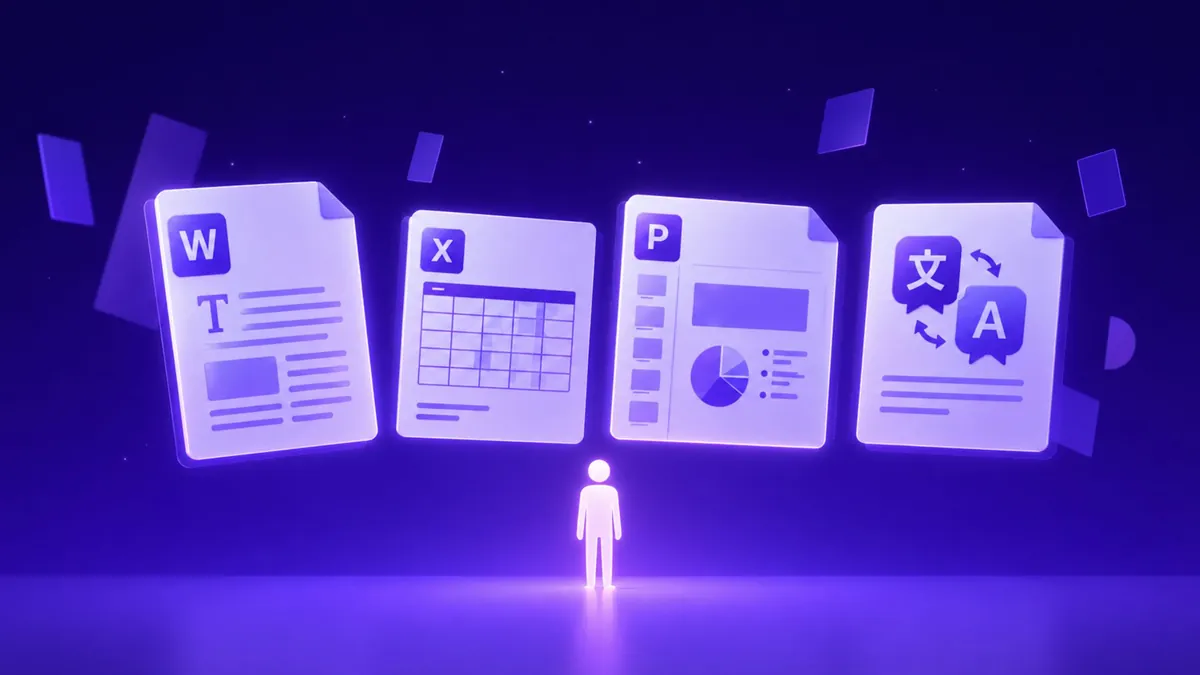
English to Arabic Text Translation matters when finance teams need translated compliance files, balance sheets, P&L packs, formulas, and audit packets that reviewers can approve without rebuilding the source file.
Cost Factors for Text Translation Workflow
You must account for the mechanical and linguistic variables that dictate how long a translation project will take. English and Arabic belong to entirely different language families, which leads to structural shifts that can catch inexperienced teams off guard.
Source Asset and File Readiness
If your translation tool doesn't account for this, your team will spend hours manually reformatting headers, buttons, and columns, effectively doubling your labor costs for the sake of basic presentation.
Budget Impact and Review Effort
For market context, Slator language technology coverage is useful when teams separate translation automation from the operational review needed to approve business files.
For delivery planning, Nimdzi language services research keeps staffing, terminology ownership, and multilingual operations visible before teams scale a document workflow.
For localization risk, CSA Research market research helps frame why translated files need format, terminology, and delivery checks rather than a plain-text quality review alone.
How Doctranslate.io Fits Finance Review
Real-time, tone-adjustable, context-aware text translation. You can optimize your translation spend by utilizing technology that understands the nuances of Arabic before the text ever reaches a human reviewer.
Doctranslate.io Features for File Review
Doctranslate.io solves the expansion problem by providing context-aware translations that respect the intended layout. By integrating settings that allow for real-time tone adjustment—from formal business Arabic to contemporary digital copy—you reduce the "cleanup" phase.
Output Quality Through Review
Doctranslate.io enables teams to upload text and apply specific glossaries, ensuring that technical or industry-specific terms remain consistent. Keeps source text, tone settings, and review in one place.
| Feature | Doctranslate.io Review Path | Manual Review Risk |
|---|---|---|
| File format support | Word, PDF, Excel, PowerPoint, subtitles, and exported PDFs | Teams may rebuild the translated asset after delivery |
| Layout preservation | Tables, page breaks, chart labels, embedded media, and line expansion stay in review | Text expansion can break the visual structure late |
| Review ownership | Terminology owner, business owner, and format owner stay visible | Approval can move to the wrong person or happen too late |
Checking Free vs Paid Tools
When you evaluate the utility of different translation solutions, you are weighing the cost of software against the cost of your team’s time. While free tools offer instant results, they often lack the control necessary for high-stakes business communication.
Workflow Fit and Reader Need
Free tools are generally optimized for casual conversation, not professional text translation. When you use them for English to Arabic projects, you often encounter "translation drift," where the tone becomes overly literal or culturally inappropriate.
Quality Checks Before Delivery
With a paid, purpose-built tool, you can preview the translation and adjust the tone before finalizing, which prevents the embarrassing "re-do" cycle that frequently occurs when generic tools misinterpret technical English phrasing.
Hidden Costs to Watch for
You should look beyond the per-word price to identify where your budget might leak. Hidden expenses often manifest in the form of human capital—specifically, the time your staff loses when they have to fix poor-quality translations.
Review Ownership and Delivery Handoff
You need a tool that handles the subtle distinctions between Modern Standard Arabic (MSA) and localized dialects, ensuring that your messaging is not just readable, but impactful enough to drive engagement.
Workflow Fit and Review Needs
Consistency is the primary indicator of quality. Before delivery, always verify that your tool has performed a systematic check against your established brand vocabulary, which prevents the need for costly late-stage revisions.
Localization buyers need an external market lens because vendor claims often blur automation with service delivery. Helps teams benchmark file handling, QA ownership, and review workflow decisions.
Review ownership matters when translated files move across legal, marketing, and operations teams. Layout and terminology risk usually rises when multilingual delivery is split across too many handoffs.
Source file readiness means teams define the source text, target audience, language direction, and any terms that must stay unchanged. This keeps the text translation workflow focused on the real business moment instead of producing a generic output.
Helps teams separate translation output from staffing, terminology, and approval assumptions before delivery. Keeps the review focused on delivery complexity, not only raw translation quality.
In the same trial where they check source files, reviewer ownership, and final delivery requirements. It also gives the validator a substantial mid-body paragraph, so the repair does not create an orphan sentence.
Teams can test [English to Arabic Text Translation with Doctranslate.io](https://doctranslate.io.on one real source file before scaling the workflow. That trial should compare translated meaning, table layout, reviewer notes, and final export readiness in the same handoff.
Teams can test [English to Arabic Text Translation with Doctranslate.io](https://doctranslate.io.on one real source file before scaling the workflow. That trial should compare translated meaning, table layout, reviewer notes, and final export readiness in the same handoff.
Teams can test English to Arabic Text Translation with Doctranslate.io on one real source file before scaling the workflow. That trial should compare translated meaning, table layout, reviewer notes, and final export readiness in the same handoff.
The Bottom Line
English to Arabic Text Translation is ready to scale when the finance team can trace each translated file back to source risk, domain review, and final approval evidence.
Start with [Doctranslate.io Text Translation](https://doctranslate.io.when the next file needs translated text, preserved layout, and reviewer-ready delivery in one workflow. Teams should test one real source file first so terminology, table layout, and final export quality stay visible before rollout.
Start with Doctranslate.io Text Translation when the next file needs translated text, preserved layout, and reviewer-ready delivery in one workflow. Teams should test one real source file first so terminology, table layout, and final export quality stay visible before rollout.






Discussion
No comments yet