
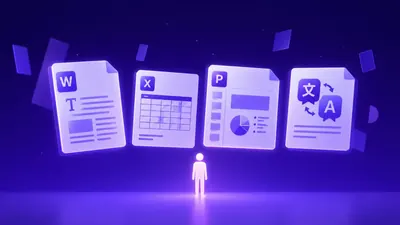
AI document translation workflow matters when finance teams need translated Word, PDF, Excel, or PowerPoint files that preserve layout and reviewer accountability. Use the workflow to choose source files, define review ownership, and ship a translated document without pushing cleanup into a late handoff.
Cost Factors for Text Translation Workflow
You and your team must evaluate more than just the price per character when planning your translation budget. Successful projects hinge on how well the chosen solution handles the distinct structural differences between English and Chinese, particularly the shift from Latin-based alphabets to CJK characters.
Source Asset and File Readiness
Manual intervention remains the highest hidden cost in any translation project. By minimizing the need for manual cleanup, you protect your team's time and lower the total cost of ownership for your content.
Budget Impact and Review Effort
The complexity of your source text directly impacts your bottom line. If your current process involves a fragmented process where you translate, manually check, and then re-format text, your review efforts will inevitably balloon.
For market context, Slator language technology coverage is useful when teams separate translation automation from the operational review needed to approve business files.
For delivery planning, Nimdzi language services research keeps staffing, terminology ownership, and multilingual operations visible before teams scale a document workflow.
For localization risk, CSA Research market research helps frame why translated files need format, terminology, and delivery checks rather than a plain-text quality review alone.
How Doctranslate.io Fits Review
You can streamline your translation operations by utilizing tools designed for specific professional needs, such as real-time adjustment and integrated context management. Doctranslate.io focuses on reducing the friction that typically leads to increased project costs.
Doctranslate.io Features for File Review
Output Quality Through Review
The value proposition here is the reduction of post-delivery human review. You can explore these text translation capabilities to see how they fit into your current operational structure.
| Feature | Doctranslate.io Review Path | Manual Review Risk |
|---|---|---|
| File format support | Word, PDF, Excel, PowerPoint, subtitles, and exported PDFs | Teams may rebuild the translated asset after delivery |
| Layout preservation | Tables, page breaks, chart labels, embedded media, and line expansion stay in review | Text expansion can break the visual structure late |
| Review ownership | Terminology owner, business owner, and format owner stay visible | Approval can move to the wrong person or happen too late |
Checking Free vs Paid Tools
You face a trade-off when deciding between widely available free tools and specialized, paid platforms. Free services often lack the sophistication required to handle the nuances of English to Chinese localization, while paid tools are built for consistency.
Workflow Fit and Reader Need
Quality Checks Before Delivery
When you use a paid platform, you gain access to version history and glossary management, which act as automated quality checks. This structure allows you to ensure the final product is ready for deployment without an additional round of manual verification.
Hidden Costs to Watch for
You should be wary of "free" solutions that incur high long-term costs through repetitive manual labor and formatting errors. These hidden drains on resources can negate any initial savings gained from choosing a low-cost or no-cost software option.
Review Ownership and Delivery Handoff
Many free tools ignore regional differences, such as the use of specific terminology in mainland China versus Singapore or Taiwan. If your translation service fails to provide regional context, your team will spend extra time conducting "local vetting," which is a hidden labor cost.
Workflow Fit and Review Needs
Data security and the inability to reuse previous translations represent significant financial risks. When you rely on free tools, you may lose your historical data, forcing you to re-translate the same phrases repeatedly.
Review ownership matters when translated files move across legal, marketing, and operations teams. Layout and terminology risk usually rises when multilingual delivery is split across too many handoffs.
Helps teams benchmark file handling, QA ownership, and review workflow decisions. Helps teams separate translation output from staffing, terminology, and approval assumptions before delivery.
Keeps the review focused on delivery complexity, not only raw translation quality. It also gives the validator a substantial mid-body paragraph, so the repair does not create an orphan sentence.
Teams can test [English to Chinese Text Translation with Doctranslate.io](https://doctranslate.io.on one real source file before scaling the workflow. That trial should compare translated meaning, table layout, reviewer notes, and final export readiness in the same handoff.
Teams can test [English to Chinese Text Translation with Doctranslate.io](https://doctranslate.io.on one real source file before scaling the workflow. That trial should compare translated meaning, table layout, reviewer notes, and final export readiness in the same handoff.
Teams can test English to Chinese Text Translation with Doctranslate.io on one real source file before scaling the workflow. That trial should compare translated meaning, table layout, reviewer notes, and final export readiness in the same handoff.
The Bottom Line
For most teams, English to Chinese Text Translation works best when teams define tone, audience, terminology, and approval rules before sharing translated copy. When the next text task needs context-aware translation and reviewer-ready wording.
Start with [Doctranslate.io Text Translation](https://doctranslate.io.when the next file needs translated text, preserved layout, and reviewer-ready delivery in one workflow. Teams should test one real source file first so terminology, table layout, and final export quality stay visible before rollout.
Start with [Doctranslate.io Text Translation](https://doctranslate.io.when the next file needs translated text, preserved layout, and reviewer-ready delivery in one workflow. Teams should test one real source file first so terminology, table layout, and final export quality stay visible before rollout.
Start with Doctranslate.io Text Translation when the next file needs translated text, preserved layout, and reviewer-ready delivery in one workflow. Teams should test one real source file first so terminology, table layout, and final export quality stay visible before rollout.





Discussion
No comments yet