
French to English Document Translation requires more than just converting individual words; it demands a seamless transition that preserves your document’s original architecture, including headers, tables, and nested graphics.
Document Translation Workflow: Technical Barriers in Cross-Language Processing
You likely encounter friction when your source document contains complex pagination or non-standard fonts that break upon conversion. Translating from French into English often results in text length fluctuations, which can push content onto new pages or force columns to misalign, creating a disjointed final product that requires significant manual cleanup.
Teams frequently struggle with layout shifts when software fails to recognize the difference between structural elements and standard body text. If your document relies on specific spacing, indentation, or image-to-text ratios, automated tools often collapse these settings, forcing you to spend hours adjusting margins and re-aligning visual assets.
French grammar relies heavily on gendered articles and complex verb conjugations that do not always map neatly to English syntax, leading to awkward phrasing if the context is missed. Xlsx that can become corrupted, leading to file errors or broken links when the document is shared with native English speakers.
Establishing a Sustainable Translation Workflow
You can stabilize your output quality by implementing a consistent review loop that addresses formatting before and after the language conversion process. By prioritizing file types that support structured data—such as preserving cell styles in spreadsheets or text boxes in presentations—you minimize the need for post-processing interventions.
Teams operate more efficiently when they assign clear language codes to source files, ensuring the system recognizes the specific nuances of French before attempting an export into English. Your primary responsibility is to ensure that source files are clean; this means removing extraneous comments, tracked changes, or locked metadata fields that might interfere with the automated processing engine.
Effective workflows rely on a clear division between initial automated conversion and final human verification of localized terminology. Assigning a specific reviewer to audit technical documents ensures that industry-specific jargon remains accurate, while the formatting specialist confirms that visual elements like charts, graphs, and table headers remain in their intended positions. For the practical workflow, French to English Document Translation with Doctranslate.io keeps the source file, target output, and review step in one place.
How Doctranslate.io Handles French to English Document Translation
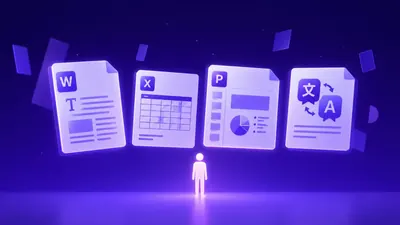
Doctranslate.io streamlines your international communications by supporting a wide range of file types, including Word, PDF, Excel, and PowerPoint, while focusing on maintaining the exact layout of your original source material. This platform manages the complex task of interpreting professional document translation requirements by mapping text back into its original containers, ensuring that your layout, fonts, and color schemes remain consistent across 100+ languages.
By automating the preservation of structural elements, Doctranslate.io mitigates the risk of "formatting drift," where files lose their visual polish during the migration process. Instead of struggling with manual page breaks or re-inserting missing images, you receive an output that is ready for immediate distribution, allowing you to focus on high-level content strategy rather than tedious file repair.
Step-By-Step Guide for Document Translation Workflow
Follow these three essential steps to move your files securely from French to English while ensuring all formatting tags remain intact.
- Sign up and authenticate: Create your account on the platform to access your personal dashboard and secure cloud workspace. 2. Xlsx file into the dashboard and initiate the translation process to let the system analyze your document structure. 3. Download your document: Once the processing finishes, save your fully translated file, which preserves your original design elements and layout constraints perfectly.
Use Cases for Document Translation Workflow
Professionals across various sectors utilize high-fidelity translation to bridge language gaps without sacrificing document quality.
- Financial Reporting: Investment firms often need to convert annual fiscal reports from French to English for international shareholders, ensuring that complex tables and data-driven spreadsheets maintain their precise row-and-column alignment. * Legal Documentation: Law firms utilize these tools to process contracts and compliance documents, where keeping the same page structure and clause numbering is essential for reference in cross-border litigations. * Marketing Collateral: Creative agencies frequently repurpose French-language brochures and third-party tools decks for English markets, relying on the tool to keep branding elements, icons, and text boxes consistent.
The Bottom Line
Document Translation workflow is a task that balances linguistic accuracy with structural preservation, requiring a tool that respects the visual integrity of your files. By leveraging automated systems that prioritize layout retention, you can eliminate the manual labor traditionally required to fix broken pages and misaligned text. For a reliable, high-fidelity experience, consider using Doctranslate.io for your next document translation project and ensure your message reaches its target audience with professional clarity.
Start with Doctranslate.io Document Translation when the next file needs a reviewed, ready-to-share output.





Discussion
No comments yet