
English to Vietnamese Document Translation requires more than simple word substitution, as HR teams must navigate structural differences between English source documents and Vietnamese terminology to ensure official records remain valid.
Why HR Teams Need English to Vietnamese Document Translation
Human Resources departments operating across international lines often struggle with the friction between English-language policy frameworks and the need for localized Vietnamese documentation. When you scale an organization, the inability to quickly convert internal training materials or employee handbooks into local languages slows down onboarding and complicates compliance.
Business Risk and Approval Context
Legal and compliance risks escalate when document versions diverge due to translation inconsistencies. A translated document that loses its formatting or shifts critical clauses can lead to misunderstandings regarding labor law requirements or benefits eligibility. Using automated, high-fidelity systems ensures that the core regulatory intent remains untouched, providing a stable audit trail for stakeholders.
Where File Complexity Creates Rework
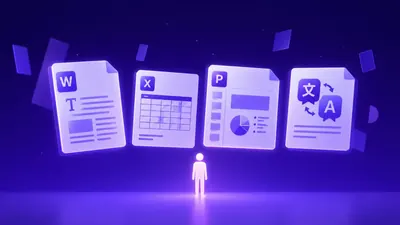
pptx, which often contain complex nested tables, headers, and footers. Manual efforts to recreate these layouts after translation introduce human error, doubling the workload for team members who should be focused on talent management rather than desktop publishing. Automated document translation effectively bridges this gap by mapping content directly into the existing structural templates.
HR Pain Points
Moving content between languages creates specific mechanical failures that disrupt HR operations, particularly when documents carry high legal weight. Teams need a solution that understands the relationship between structural file components and the translated text.
Format and Number Integrity
Translating financial records or benefit statements from English to Vietnamese introduces a significant risk: the misinterpretation of currency symbols, date formats, or numerical values. Professional translation tools address this by recognizing the semantic context of numbers, ensuring that a comma used as a decimal separator in one language is correctly handled according to the target locale's expectations.
Reviewer Ownership and Handoff
Bottlenecks emerge when translation tasks require constant oversight from bilingual staff to correct formatting errors rather than verifying the nuance of the content. By utilizing document translation services that preserve original document geometry, HR teams move toward a self-service model where reviewers can focus on tone and legal accuracy rather than checking if a signature block shifted to the wrong page. For the practical workflow, English to Vietnamese Document Translation with Doctranslate.io keeps the source file, target output, and review step in one place.
How Document Translation Fits the HR Workflow
Integrating translation directly into your existing file management cycle eliminates the "copy-paste" latency that plagues international HR coordination. Teams can automate the bulk of the preparation, leaving human experts to manage only the final verification steps.
Product Fit for the Core Workflow
When you integrate translation software into the document lifecycle, the process begins with an automated file intake that parses various formats without disrupting their visual structure. For teams managing large volumes of English documentation, this creates a seamless path to Vietnamese, as the software maintains font styles, indentation, and page breaks across over 100 languages.
Review Controls Before Delivery
High-stakes documents benefit from an intermediate review stage where localized glossaries can be applied to maintain corporate brand voice. This control allows HR leaders to override generic phrasing with specific company-approved terminology, ensuring the translated output matches the existing English brand identity perfectly. For this criterion, check source context, terminology ownership, layout risk, and delivery readiness before the team shares the final output.
Real Use Cases in HR
HR departments often face the challenge of reconciling corporate-wide standards with local office requirements. Having a reliable method for converting high-density informational files is a daily necessity in these environments.
High-Value Team Scenarios
- Employee Handbook Updates: Distributing 50-page orientation packets that look identical in both English and Vietnamese is vital for maintaining a unified corporate culture. * Payroll Benefit Summaries: Ensuring that numerical values within complex Excel spreadsheets are accurately mapped to translated labels prevents payroll disputes and miscommunication. * Performance Evaluation Records: Enabling managers to fill out reports in their preferred language while keeping the organizational reporting structure consistent.
Where Manual Review Still Matters
While automated tools handle the heavy lifting of structural integrity, human subject matter experts remain essential for localized nuances. Cultural idioms or specific regional labor law phrasing in Vietnam may require a human touch to ensure the document resonates correctly with local staff. Automated translation should be viewed as a foundational layer, providing a polished draft that saves teams from the labor of building a document from scratch.
ROI for HR Teams
Efficiency gains are measured by the total time reclaimed by HR administrators who are no longer performing manual formatting. By reducing the reliance on external vendors for routine internal documentation, companies can redistribute those funds toward direct employee engagement activities.
Time Savings and Cleanup Reduction
When you eliminate the manual re-formatting stage, turnaround times for department-wide updates drop from days to hours. This creates an exponential improvement in productivity, as updates that previously languished in a backlog can now be deployed as soon as the source English version is finalized.
Budget Impact and Review Effort
Direct translation costs are only one part of the budget; the hidden cost of "review time" is often the most significant drain on HR resources. When documents require minimal cleanup, the total cost of ownership for localized documentation drops, allowing teams to scale their international presence without a corresponding increase in operational overhead.
The Bottom Line
Effective HR communication across borders depends on the ability to deliver accurate, professionally formatted information without structural loss. By leveraging automated systems that prioritize file integrity, teams can drastically reduce the administrative burden of maintaining localized document libraries. To begin optimizing your own translation workflow today, explore the features available through Doctranslate.io document translation to see how you can maintain high standards while scaling your international operations.
Start with Doctranslate.io Document Translation when the next file needs a reviewed, ready-to-share output.





Discussion
No comments yet