
Executing an accurate Polish to English Document Translation requires more than just replacing vocabulary; it demands a sophisticated approach to maintain the integrity of complex source files like.docx,.xlsx, or.pdf.
Document Translation Workflow: Barriers to Successful Cross-Language Conversion
You face significant friction in this workflow because Polish grammar requires different space and character handling checked to the more streamlined structure of English. When your source files contain long, case-heavy Polish sentences, the resulting English output often demands a layout that can accommodate different sentence lengths and densities without shifting your headers or image placement.
- Format Fragility: Standard copy-pasting or basic extraction tools frequently destroy the grid lines in Excel files or the carefully positioned text boxes in PDF documents. * Quality Risks: Because Polish uses a highly inflected case system, a literal machine swap often produces "stiff" English that ignores contextual nuance, leading to unprofessional or ambiguous translations. * Review Burden: Teams frequently find themselves spending more time manually fixing broken page breaks and re-aligning document elements than they actually spend on the linguistic review of the translated content.
Establishing High-Integrity Translation Cycles
Teams that succeed in international communication prioritize a consistent, file-aware methodology over simple text extraction. You should implement a system that treats the file’s structure—its fonts, margins, and object layers—as equally important as the words themselves. By utilizing document translation services that keep the original file architecture intact, you eliminate the need for costly manual reformatting after the language conversion is complete.
- Language-Aware Extraction: Your chosen method should recognize Polish characters (like ą, ć, ę, ł, ń, ó, ś, ź, ż) as distinct tokens rather than errors, ensuring that the target English text flows naturally into the vacated space. * Consistency Requirements: High-quality results depend on a review process where the person verifying the text has access to the source file layout, preventing context-blind edits that might alter the intended meaning or tone. * Technical Standardization: Professional workflows should mandate that all source files follow naming conventions that indicate the language code "pl" and the intended target "en," which helps in tracking versions and maintaining audit trails for legal or technical documentation.
For the practical workflow, Polish to English Document Translation with Doctranslate.io keeps the source file, target output, and review step in one place.
How Doctranslate.io Handles Complex File Conversion
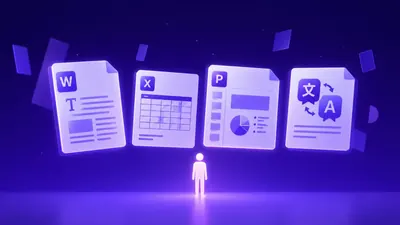
Doctranslate.io provides a purpose-built solution that handles the structural challenges of Polish to English Document Translation by mapping your file's specific layout components before translation begins. The engine analyzes your source file—whether it is a Word document, a complex PDF, an Excel workbook, or a PowerPoint deck—and locks the positioning of all non-text elements. This allows you to handle over 100 languages without worrying that your translated file will lose its professional visual presentation.
By applying advanced spatial recognition, the platform ensures that the translated English text respects the boundaries of your original cells and frames. This approach fundamentally solves the "layout drift" issue that occurs when word counts fluctuate between the highly complex morphology of Polish and the leaner syntactic requirements of English. Because the system maintains the underlying XML or metadata structure of your files, you receive a document that is ready for immediate distribution, saving you from the tedious manual labor of resetting margins or re-inserting images.
Step-By-Step Translation Workflow
Streamlining your output is simple when you utilize a direct-to-file processing path. Follow these three steps to convert your Polish assets into professional-grade English documents.
- Create Your Account: Access the platform by registering your professional details, which allows you to track all your historical document projects and manage your preferences for language pairs. 2. Pdf—and prepare it for language processing. 3. Export the Result: Once the engine completes the conversion, you can instantly download the translated file, which will arrive with the exact layout, font styles, and visual integrity of your original source document.
Industry Applications for Polish to English Conversion
Businesses operating in the European market frequently rely on efficient conversion cycles to keep international stakeholders informed. Whether you are managing legal contracts, technical manuals, or quarterly financial reports, the ability to translate content without disrupting the document's design is essential for maintaining credibility.
- Technical Documentation: Engineering teams use this to update user manuals for global product launches, ensuring that labels, diagram descriptions, and instruction sets remain perfectly aligned across versions. * Financial Reporting: Accounting departments rely on this for converting balance sheets and tax forms where maintaining cell structure and numerical formatting is critical for accuracy and compliance. * Marketing Collateral: Creative teams translate brochure content and event slides while preserving branded layouts, allowing for a rapid rollout of campaigns that look exactly the same in every target region.
The Bottom Line
Successfully bridging the gap between Polish and English assets requires a tool that respects the underlying architecture of your files. By automating the preservation of your layouts, tables, and images, you can focus on the message rather than the mechanics of formatting. Experience seamless results for your next project by visiting Doctranslate.io for professional document translation.
Start with Doctranslate.io Document Translation when the next file needs a reviewed, ready-to-share output.





Discussion
No comments yet