
Achieving a high-quality Turkish to English Document Translation requires more than just swapping vocabulary, as the agglutinative nature of Turkish often leads to significant text expansion or contraction during conversion.
Document Translation Workflow: Technical Barriers in Cross-Language Documentation
You face significant friction because Turkish utilizes a suffix-heavy structure, whereas English relies on specific word order and distinct prepositions. When teams translate long-form documents, the resulting text often occupies more physical space on a page than the original, pushing tables out of their headers and forcing images to overlap with text blocks. This formatting drift is a common point of failure for manual translation, especially with files that include complex nested lists or embedded charts.
Your team likely deals with files that contain specific metadata and design elements. Without a tool that understands the internal code of a file, you may end up with broken lines or corrupted character sets that make the English output illegible. High-quality output requires that the system recognizes how to treat headers, bullet points, and cell borders in a static document environment to prevent manual layout repair later.
The disparity between Turkish and English sentence structures often creates a loss of context if the process ignores the document's broader narrative. Professionals must ensure that terminology remains consistent across a multi-page PDF or a massive Excel workbook. Without an automated review mechanism, discrepancies in professional jargon can lead to misunderstandings in client-facing documents, making it vital to use tools that maintain internal terminology consistency throughout the conversion process.
Essential Components of a Pro Workflow
Organizations achieve superior results when their translation process is anchored by standardized file handling and automated layout verification. You should ensure that your workflow includes a mechanism for maintaining file headers, metadata, and graphical positioning, as these are the first elements to break during standard manual copy-paste operations. By consolidating these steps, you reduce the time your editors spend on cosmetic corrections and allow them to focus solely on linguistic accuracy.
Pptx without requiring extra conversion stages. Using a professional document translation portal allows you to bypass the need for tedious manual formatting, as the tool handles the structural mapping of the original source file. This saves hours of labor, particularly when dealing with long contracts or extensive slide decks where formatting consistency determines the professional quality of the output.
The ideal workflow designates a specific phase for human review of technical terms after the primary conversion happens. Even with highly accurate automated systems, industry-specific nuances in the target-language output require a subject matter expert to verify that the tone and vocabulary match the intent of the original Turkish source. Establish a feedback loop where the translated output is reconciled against the master source to ensure that all numeric values and legal definitions remain precise across every page.
For the practical workflow, Turkish to English Document Translation with Doctranslate.io keeps the source file, target output, and review step in one place.
How Doctranslate.io Handles Complex Conversions
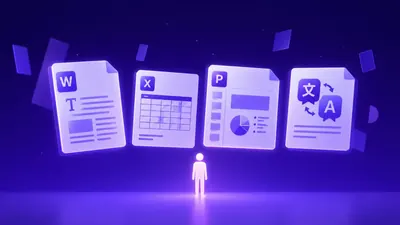
Doctranslate.io optimizes the Turkish to English conversion process by focusing on the preservation of the original file's structural blueprint. Because the platform natively supports a massive variety of file types including PDFs, Excel spreadsheets, and PowerPoint presentations, it maps the text while leaving the underlying layout, fonts, and graphical objects in their original positions. This ensures that you receive a file that looks and feels like your source document, regardless of the language change.
Your team no longer needs to manually re-adjust page margins or table sizes, as the engine accounts for the natural variations in word length inherent in Turkish to English shifts. By processing documents through a system designed for multi-format support, you bypass the common errors associated with traditional copy-pasting, such as broken hyperlinks or missing font styles. This efficiency provides a stable foundation for your international documentation, allowing you to scale your content delivery across global markets without technical overhead.
Step-By-Step Guide for Document Translation Workflow
Follow these three simple steps to convert your files efficiently using Doctranslate.io:
- Sign up: Create your account on the platform to access the secure file processing interface. 2. Docx—and choose Turkish as the source language and English as the target. 3. Download/Copy: Once the system confirms the conversion is complete, download the translated version that retains your original layout and formatting.
Business Scenarios for Automated Translation
- Legal Contract Review: International law firms use automated translation to quickly digest the clauses of a Turkish partnership agreement, allowing English-speaking legal teams to identify key obligations before formal human review. * Corporate Financial Reporting: Accounting departments convert quarterly performance summaries from Turkish to English, ensuring that all tables, rows, and financial cells remain perfectly aligned for executive stakeholders. * Technical Manual Updates: Manufacturers update their product documentation by translating instructional guides, ensuring that diagrams and headers stay intact while the descriptive text is localized for new English-speaking regions.
The Bottom Line
Turkish to English document conversion should not be a manual burden that breaks your file layouts or disrupts your team's productivity. By leveraging a dedicated platform like Doctranslate.io, you protect your formatting and ensure linguistic accuracy across all your critical business files. Get started with your document translation today and see how much time your team saves when they stop manual reformatting.
Start with Doctranslate.io Document Translation when the next file needs a reviewed, ready-to-share output.





Discussion
No comments yet