Professional teams often rely on high-stakes files like quarterly P&L packs or multi-page audit workpapers, yet standard translation software frequently collapses these layouts.
AI Document Translation: Why Teams Struggle with Rigid File Architectures
Legacy translation tools often strip formatting during extraction, forcing finance and global operations teams to spend more time on manual post-translation reconstruction than on the translation itself. This friction is most apparent when handling complex business assets where a single misaligned row in a balance-sheet footnote can invalidate the entire document for a reader.
The Breakdown of Tabular Data
Finance teams often work with highly structured files where formula cells and embedded tables are essential for data integrity. Traditional engines treat these elements as simple strings, which frequently leads to the loss of cell-based calculations or the complete collapse of grid alignment. When an Excel sheet with 50 rows of tax-provision data loses its column structure, the resulting workpaper becomes unusable, forcing staff to manually paste content back into the original grid.
Model Capability vs Delivery Risk
Fragmented workflows mandate that users manually re-map headers, font sizes, and image placements after the translation engine returns the text. This "copy-paste" cycle effectively doubles the time-to-market for critical reports. For organizations handling daily audit packets or legal disclosures, this clerical bottleneck prevents the team from focusing on actual content review and compliance verification.
Requirements for Reliable Localization Workflows
A high-performance system must treat the structural metadata of a file with the same priority as the semantic meaning of the words themselves. Without this dual-layer intelligence, the output is merely a text dump rather than a production-ready document that reflects the brand identity and layout precision of the source.
Protecting Sensitive Numerical Data
Workflows designed for finance professionals must ensure that numerical sequences and embedded formulas remain untouched by the linguistic translation engine. When managing evidence schedules, the software needs to recognize the specific delimiters of a spreadsheet to prevent accidental truncation of figures. If the engine alters a decimal separator in a control note, it risks introducing a material error into the final financial report.
Export Readiness Review Before Handoff
Organizations that operate across 100+ languages face the constant threat of terminology drift in their compliance files. A robust system employs centralized terminology management to ensure that specific industry phrases—such as "accrued expenses" or "internal control framework"—remain uniform regardless of the target locale. By enforcing these constraints at the engine level, you prevent linguistic ambiguity that could lead to regulatory scrutiny during an external audit.
For the practical workflow, AI Document Translation with Doctranslate.io keeps the source file, target output, and review step in one place.
How Doctranslate.io Reduces Review Cleanup
Doctranslate.io resolves layout drift by utilizing an AI engine that maps the coordinate space of the source document directly to the target-language output output. Instead of flattening the document, the software anchors every translated string to its original location, ensuring that page breaks, font styles, and header margins remain identical to the source.
Preserving Layout Integrity for Complex Assets
This coordinate-based approach eliminates the need for manual adjustment of image alignment or text-wrapping in documents containing dense infographics. Because the system tracks the spatial constraints of the document, it prevents text expansion from breaking the visual design of slide decks or PDF manuals. This capability allows teams to move directly from the translation stage to final internal approval without needing to engage a desktop publisher to fix layout errors.
Quality Checks and Reviewer Roles
By automating the structural mapping, the platform ensures that even the most complex layout remains intact during the transformation process. You can upload a document containing multiple nested lists and proprietary font templates, and the engine will return a file that functions as a structural mirror of the original.
Step-By-Step File Translation Process
The following workflow enables teams to process high-volume documentation efficiently while retaining the exact specifications of the source material. By standardizing this approach, you ensure that every document meets your internal quality requirements.
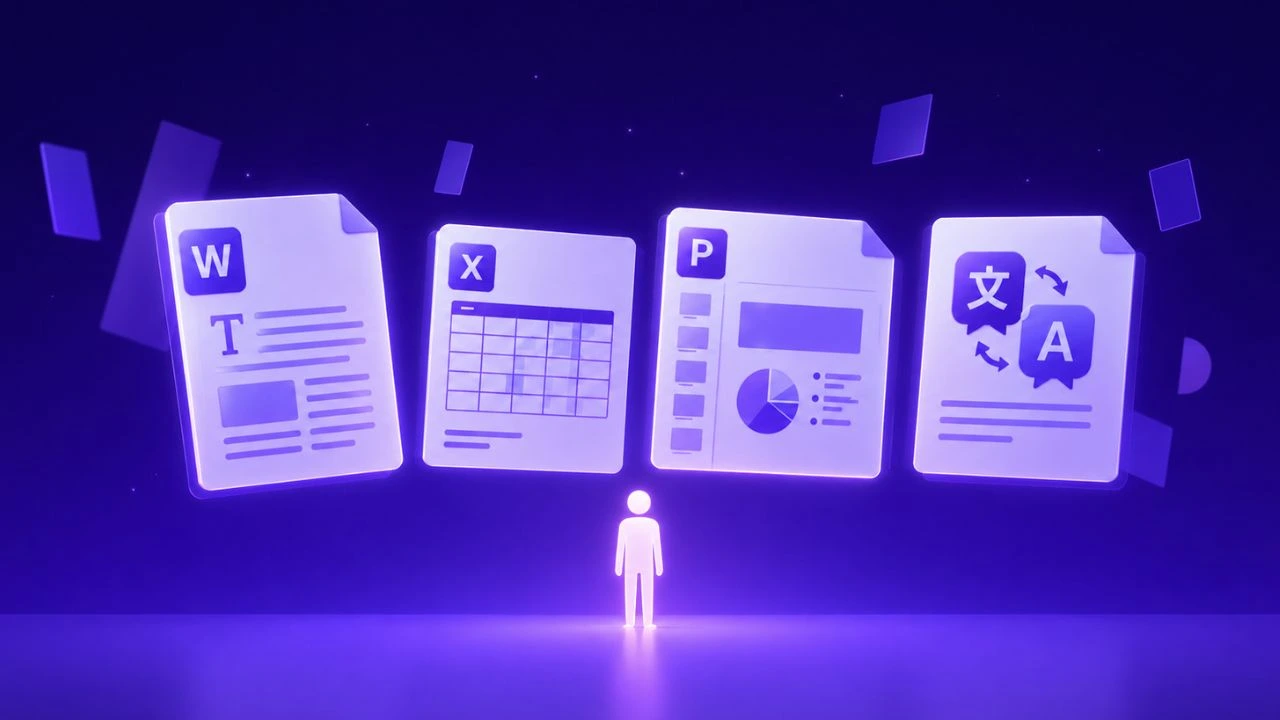
- Platform Ingestion: Upload your file, such as a Word report or PPT deck, directly into the document translation portal while specifying your target language. * Structural Mapping: The engine analyzes the file architecture, identifying internal formula cells, table grids, and paragraph styles to lock them in place before the translation begins. * Intelligent Synthesis: The AI translates the text while maintaining the coordinate integrity of every element, ensuring that the final file looks like the original. * Validation and Export: You download the finalized asset, which is ready for use in professional audit packets, financial reports, or client-facing proposals without additional manual reformatting.
Use Cases by Team and Asset
Different functional teams rely on specific file formats that require tailored handling to ensure data accuracy and visual consistency. Whether dealing with financial audit trails or marketing collateral, the platform adapts to the specific constraints of the asset type.
Financial Reporting and Audit Documentation
Finance teams require flawless accuracy when translating P&L packs and close calendar documents. The platform protects the underlying formulas in Excel sheets, ensuring that calculations remain functional post-translation. This precision is vital for creating audit-ready evidence schedules and exception notes where every cell value must be verifiable.
Section-Level Approval Decision
Global teams frequently translate complex slide decks and PDF manuals that contain heavy infographic content. Maintaining the precise placement of charts and icons is essential for corporate messaging. The system preserves the specific spatial relationships between images and text, ensuring that the brand standards remain consistent across all regional offices.
Conclusion
Modern business operations require tools that prioritize both linguistic precision and layout integrity to succeed in a global market. By moving away from manual formatting cleanup and embracing intelligent, coordinate-aware systems, teams can drastically reduce their time-to-market for critical business documentation. Doctranslate.io offers a professional document translation solution designed to handle the complexity of finance, legal, and operational files, ensuring your team spends more time acting on information rather than fixing document layouts.
Start with Doctranslate.io Document Translation when the next file needs a reviewed, ready-to-share output.





Discussion
No comments yet