The AI document translation market has more options than ever. But most buyers pick wrong — not because they chose a bad tool, but because they evaluated features instead of fit.
Quick answer: If you're translating simple, clean documents occasionally, Google Translate or DeepL free tiers cover most needs. If your documents are complex, scanned, or need to look professional after translation, you need a tool built specifically for layout preservation. The breakdown below explains which tool fits which situation.
How We Evaluated
To keep this comparison grounded rather than spec-sheet-based, we assessed each tool on three criteria:
- Layout preservation — does the output match the original's visual structure on a document with tables and columns?
- Scanned PDF handling — does the tool include OCR, or does it require a separate pre-processing step?
- Language coverage and quality — particularly for Asian and Middle Eastern language pairs, where tools vary significantly
Pricing and file limits are drawn from each tool's public pricing page as of April 2026.
Quick Comparison Table
| # | Tool | Best For | Starting Price | Key Strength | Key Limitation |
|---|---|---|---|---|---|
| 1 | Doctranslate.io | Complex layouts, scanned PDFs, Asian language pairs | Free trial; from $19.99/mo | Coordinate-level layout preservation + auto OCR | No unlimited free tier |
| 2 | DeepL | European language pairs, clean documents | Free; Pro from $8.74/mo | Best translation quality for European pairs | 3 file types only; no OCR for scanned PDFs |
| 3 | Google Translate | Quick checks, widest language coverage | Free | 249 languages; instant results | Poor layout preservation on complex docs |
| 4 | Microsoft Translator | Microsoft 365 teams, API at scale | Free (2M chars/mo) | Native M365 integration; generous free API | Quality below DeepL on European pairs |
| 5 | Taia | Teams needing translation memory + human review | Free (5,000 words/mo) | 65+ file types, 189 languages, TM + glossary | More complex setup than upload-and-translate tools |
| 6 | Smallpdf | Occasional scanned PDF translation | Free (2 tasks/day) | Built-in OCR; no extra steps | Free tier shared across all Smallpdf tools |
| 7 | iLovePDF | Simple layouts, bilingual output | Free (1/day); $4/mo | Bilingual output on free tier | Only 25 target languages |
How to Choose: Three Questions First
What types of documents are you translating? A simple text PDF and a multi-column financial report are not the same problem. Tools that handle one well often fail on the other.
Does formatting matter? For internal rough reads, broken formatting is an inconvenience. For client-facing documents, contracts, or published materials, it's a dealbreaker.
How often do you translate? A free tool that requires 30 minutes of reformatting per document isn't actually free for a regular user.
The Tools
1. Doctranslate.io — Best for Complex Layouts and Scanned PDFs
Doctranslate.io Document Translation processes the document structure before translation begins — mapping columns, tables, and their spatial coordinates — then re-inserts translated text at the coordinate level. For scanned PDFs, OCR runs automatically as part of the same pipeline.
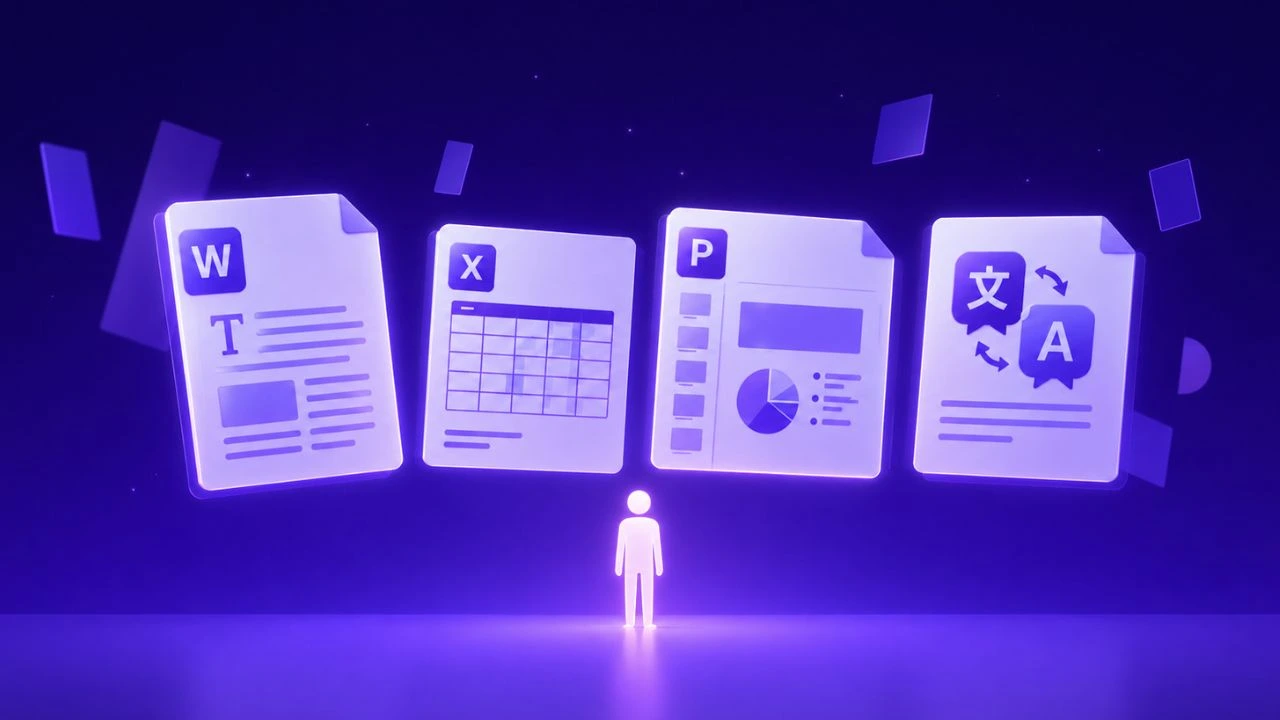
Supported formats: PDF, DOCX, PPTX, XLSX. Languages: 100+, with strong coverage of Japanese, Chinese (Simplified and Traditional), Korean, Vietnamese, and Arabic. Free trial available; paid plans start at $19.99/month.
The same platform covers visual translation (images and screenshots) and media translation (audio and video), so it's worth considering if your workflow involves more than documents.
Best for: Professionals and teams translating complex documents — contracts, academic papers, financial reports — where formatting needs to be intact in the output.
2. DeepL — Best Translation Quality for European Pairs
DeepL consistently produces more natural-sounding output than Google Translate for European language pairs. After expanding to 100+ languages in January 2026 , it now covers most major language pairs. Free tier: 3 files/month, 5MB per file, no branded output.
The limitation: no native OCR for scanned PDFs on the web tool (desktop app only). Complex table layouts can break. Asian and Middle Eastern language pairs are newer additions with less training data.
Best for: European language specialists, clean non-scanned documents, users where translation quality outweighs layout complexity.
3. Google Translate — Best Free Option, Widest Coverage
Google Translate supports 249 languages as of April 2026 — more than any other tool on this list. Document upload is free with no registration for files under 10MB and 300 pages.
The tradeoff: complex layouts break more easily than on purpose-built document translators. Scanned PDFs are not supported. Tables and multi-column designs frequently reflow into plain text.
Best for: Quick translation of clean, text-based documents in any language. Not suitable for professional output.
4. Microsoft Translator — Best for Microsoft 365 Teams
Microsoft Translator integrates natively with Word, PowerPoint, Teams, and Azure. The free API tier offers 2 million characters per month. For teams already in the Microsoft ecosystem, it's the lowest-friction option.
Base translation quality for European pairs ranks below DeepL in most benchmarks. Outside the Microsoft ecosystem, it offers less differentiation.
Best for: Enterprise teams running on Microsoft 365 who want translation without adding a new vendor.
5. Taia — Best for Teams Translating at Volume
Taia is built for business teams translating recurring document types. Translation memory stores and reuses previously approved phrasing. Glossaries enforce brand terminology. Optional human review is available per project. 65+ file formats, 189 languages, free tier includes 5,000 words/month.
Best for: Teams translating the same document types repeatedly (contracts, manuals, HR materials) where consistency across projects matters.
6. Smallpdf — Best Free Option With OCR
Smallpdf includes built-in OCR — the key advantage over Google Translate for scanned document translation. The free tier allows 2 tasks per day across all Smallpdf tools. Suitable for occasional scanned PDF translation at no cost.
Best for: Occasional translation of scanned documents without paying for a dedicated tool.
7. iLovePDF — Best for Bilingual Output
iLovePDF offers bilingual output — original and translated text side by side — on its free tier. Unique differentiator no other free tool on this list provides. Constraints: 25 target languages, 1 free task per day, 15MB file limit.
Best for: Translators or researchers who need to compare source and translated text directly.
Decision Framework
| If you need... | Use this |
|---|---|
| Complex layout preserved — tables, columns intact | Doctranslate.io |
| Best quality for European language pairs | DeepL |
| Widest language coverage, free | Google Translate |
| Document translation inside Microsoft 365 | Microsoft Translator |
| Volume + consistency across recurring document types | Taia |
| Scanned PDF, free, no daily limits elsewhere | Smallpdf |
| Bilingual output (source + translation side by side) | iLovePDF |
Common Mistakes When Choosing
Choosing by language count alone. A tool claiming 200+ languages doesn't automatically perform well on all of them. Test on your actual language pair before committing.
Ignoring the scanned PDF problem. Google Translate fails completely on scanned PDFs. Most free tools do. Check OCR support before uploading.
Treating "free" as actually free. A free tool that requires 30 minutes of reformatting per document has a real cost. Calculate time, not just subscription fees.
Frequently Asked Questions
Which document translation software is best for free use? Google Translate (249 languages, free) for clean text-based files. DeepL (3 files/month free) for better quality on European pairs. Smallpdf (2 tasks/day free) for scanned PDFs with OCR.
Does document translation software preserve formatting? It depends on the tool and document complexity. Simple, single-column PDFs survive most tools. Complex layouts require a tool with structural parsing and coordinate-level re-insertion.
What's the best tool for Asian language document translation? DeepL only recently added Vietnamese and Thai; Asian language support remains less refined than its European core. For Japanese, Chinese, Korean, and Vietnamese with layout preservation, Doctranslate.io covers those pairs specifically.
Can these tools handle scanned PDFs? Not all. Smallpdf, iLovePDF, and Doctranslate.io include OCR automatically. Google Translate and DeepL's web tool do not support scanned PDF translation.
What to Do
Narrow to two tools before testing anything. Use the decision framework above to eliminate options that don't fit your document type or language pair. Then run one real document from your actual workflow through each tool and compare the output side by side.




Discussion
No comments yet