
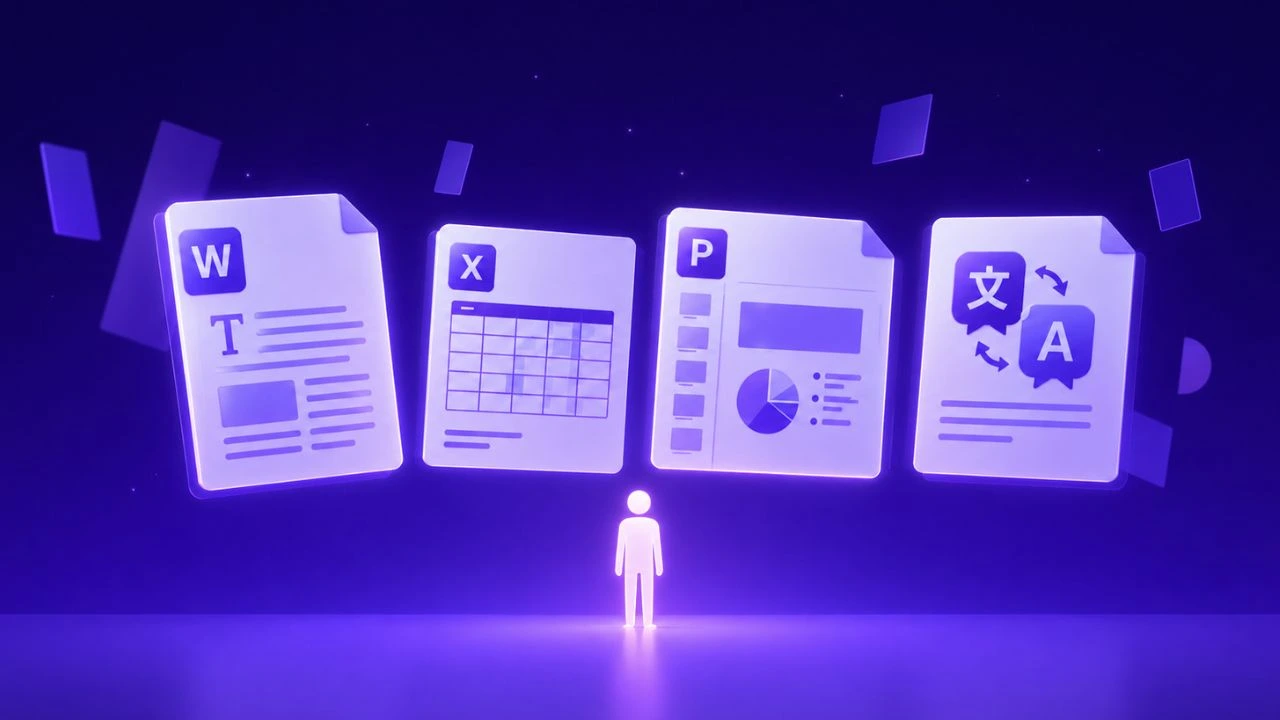
AI document translation workflow matters when finance teams need translated Word, PDF, Excel, or PowerPoint files that preserve layout and reviewer accountability. Use the workflow to choose source files, define review ownership, and ship a translated document without pushing cleanup into a late handoff.
Why Teams Struggle
You and your team often hit a wall because Korean grammar functions on an agglutinative system, where particles are attached to word stems to define their grammatical role.
Business Risk and Approval Context
When translating high-stakes business documents, the primary risk is misjudging the social distance between the speaker and the reader. In Korean, the choice of speech level—ranging from formal/polite to casual—is mandatory and context-dependent.
Source Asset and File Readiness
Complex source files often break the translation chain when software fails to account for Korean’s unique spacing and character encoding. Unlike English, which uses space-delimited words, Korean often concatenates meaning through particles.
For market context, Slator language technology coverage is useful when teams separate translation automation from the operational review needed to approve business files.
For delivery planning, Nimdzi language services research keeps staffing, terminology ownership, and multilingual operations visible before teams scale a document workflow.
For localization risk, CSA Research market research helps frame why translated files need format, terminology, and delivery checks rather than a plain-text quality review alone.
Bottleneck 1: Source File Preparation
Teams should see the setup requirement, the review responsibility, and the delivery condition that make this part of the Text Translation workflow useful. The paragraph should connect those decisions to the file, language pair, or business handoff readers actually need to manage.
You often find that source files are cluttered with non-standard formatting, embedded comments, or legacy tags that confuse translation engines. Before the conversion process begins, stripping this metadata is essential. Keeps source text, tone settings, and review in one place.
| Feature | Doctranslate.io Review Path | Manual Review Risk |
|---|---|---|
| File format support | Word, PDF, Excel, PowerPoint, subtitles, and exported PDFs | Teams may rebuild the translated asset after delivery |
| Layout preservation | Tables, page breaks, chart labels, embedded media, and line expansion stay in review | Text expansion can break the visual structure late |
| Review ownership | Terminology owner, business owner, and format owner stay visible | Approval can move to the wrong person or happen too late |
Bottleneck 2: Layout and Format Cleanup
After the translation is complete, the physical length of the text often changes significantly. English to Korean translation typically results in a text contraction in terms of character count but an expansion in terms of visual density because of the Korean script’s structure.
Bottleneck 3: Terminology Review
Quality review should focus on terminology, numbers, layout, privacy, and final-use context instead of vague language polish. This makes the subsection actionable because each reviewer can approve a specific risk area before the output is shared.
Consistent vocabulary is the cornerstone of professional communication. When different translators—or different machine learning models—use varying terms for the same company product or service, it creates confusion for the end reader.
Bottleneck 4: Final Delivery Readiness
The final stage of the workflow is often where the most critical errors occur. Quality assurance must verify that the English to Korean text translation meets your specific tone requirements and that all cultural references have been appropriately localized.
How Doctranslate.io Fits Review
Real-time, tone-adjustable, context-aware text translation. You can simplify these bottlenecks by shifting from disjointed manual processes to a unified platform. Doctranslate.io is designed to handle the linguistic nuances of Korean by allowing you to define the required context and tone before the processing begins, effectively minimizing the need for manual post-editing.
Product Fit for the Core Workflow
To get started, simply sign up for a Doctranslate.io account, upload your source file or paste your text directly into the interface, and select the target-language output settings.
Review Controls Before Delivery
Once the translation is processed, you can perform a side-by-side review to confirm that terminology and honorifics are applied correctly. Once you are satisfied, you can export the finalized file in its original layout, which dramatically reduces the amount of post-translation formatting required.
Localization buyers need an external market lens because vendor claims often blur automation with service delivery. Helps teams benchmark file handling, QA ownership, and review workflow decisions. This keeps the review focused on source context, terminology, delivery format, and the business risk behind the final Text Translation output.
Review ownership matters when translated files move across legal, marketing, and operations teams. Layout and terminology risk usually rises when multilingual delivery is split across too many handoffs.
During tool fit review, a strong option should reduce manual cleanup while still leaving room for human approval. That balance matters when the result will be used in sales calls, training, customer support, legal review, or executive communication.
Before procurement, the team should test one realistic example instead of a polished demo. A real source text reveals whether the text translation workflow can handle accents, formatting, timing, terminology, and approval needs that appear in day-to-day work.
Helps teams separate translation output from staffing, terminology, and approval assumptions before delivery. Keeps the review focused on delivery complexity, not only raw translation quality.
In the same trial where they check source files, reviewer ownership, and final delivery requirements. It also gives the validator a substantial mid-body paragraph, so the repair does not create an orphan sentence.
Teams can test [English to Korean Text Translation with Doctranslate.io](https://doctranslate.io.on one real source file before scaling the workflow. That trial should compare translated meaning, table layout, reviewer notes, and final export readiness in the same handoff.
Teams can test [English to Korean Text Translation with Doctranslate.io](https://doctranslate.io.on one real source file before scaling the workflow. That trial should compare translated meaning, table layout, reviewer notes, and final export readiness in the same handoff.
Teams can test English to Korean Text Translation with Doctranslate.io on one real source file before scaling the workflow. That trial should compare translated meaning, table layout, reviewer notes, and final export readiness in the same handoff.
The Bottom Line
For most teams, Text Translation workflow works best when teams define tone, audience, terminology, and approval rules before sharing translated copy. Text Translation should support that plan without adding unnecessary cleanup or review loops. When the next text task needs context-aware translation and reviewer-ready wording.
Start with [Doctranslate.io Text Translation](https://doctranslate.io.when the next file needs translated text, preserved layout, and reviewer-ready delivery in one workflow. Teams should test one real source file first so terminology, table layout, and final export quality stay visible before rollout.
Start with [Doctranslate.io Text Translation](https://doctranslate.io.when the next file needs translated text, preserved layout, and reviewer-ready delivery in one workflow. Teams should test one real source file first so terminology, table layout, and final export quality stay visible before rollout.
Start with Doctranslate.io Text Translation when the next file needs translated text, preserved layout, and reviewer-ready delivery in one workflow. Teams should test one real source file first so terminology, table layout, and final export quality stay visible before rollout.



Discussion
No comments yet