
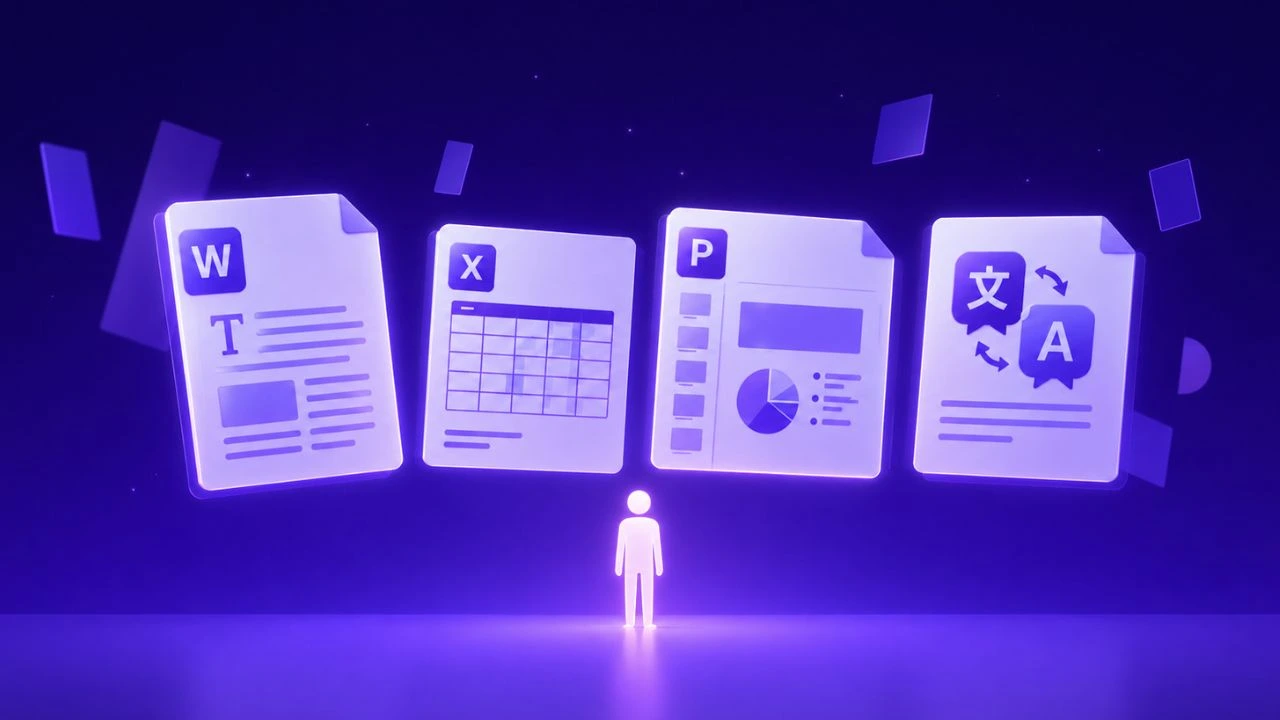
AI document translation workflow matters when finance teams need translated Word, PDF, Excel, or PowerPoint files that preserve layout and reviewer accountability. Use the workflow to choose source files, define review ownership, and ship a translated document without pushing cleanup into a late handoff.
What to Look for in a Text Translation Workflow Tool
You need a solution that respects the linguistic architecture of Portuguese. Unlike English, Portuguese is highly inflected, meaning nouns, adjectives, and articles must agree in gender and number, which often causes errors in basic translation engines.
Workflow Fit and Reader Need
When evaluating tools, prioritize those that offer a seamless path from input to final output. Your team needs to move quickly without constant manual intervention, meaning the interface should support direct text entry or file uploads without requiring complex technical setups.
Quality Checks Before Delivery
Look for platforms that highlight ambiguous segments where context is lacking, as these are where most translation errors originate. For this criterion, check source context, terminology ownership, layout risk, and delivery readiness before the team shares the final output.
For market context, Slator language technology coverage is useful when teams separate translation automation from the operational review needed to approve business files.
For delivery planning, Nimdzi language services research keeps staffing, terminology ownership, and multilingual operations visible before teams scale a document workflow.
For localization risk, CSA Research market research helps frame why translated files need format, terminology, and delivery checks rather than a plain-text quality review alone.
How We Evaluated These Tools
We assessed each platform based on its ability to handle linguistic complexities and the speed at which you can reach a publication-ready state. We prioritized solutions that minimize the time spent on post-editing while maximizing grammatical precision.
Source Evidence and Export Readiness
Each platform was tested for its ability to preserve formatting and document structure. We examined how easily a user could define the tone—professional, casual, or technical—and whether the tool offered real-time feedback.
Delivery Risk and Review Needs
We evaluated the error-correction features of each tool, specifically testing for text expansion, which is common when translating English to Portuguese—often resulting in a 15-20% increase in character count. A high-quality tool should account for this space requirement automatically, preventing layout breaks in your final documents. Keeps source text, tone settings, and review in one place.
Review the Top Tools Before Choosing
Navigating the market for translation software requires balancing cost, speed, and precision. Here is how leading solutions compare. This keeps the review focused on source context, terminology, delivery format, and the business risk behind the final Text Translation output.
Review Ownership and Delivery Handoff
Real-time, tone-adjustable, context-aware text translation. Doctranslate.io stands out by offering context-aware translation that adapts to your specific brand voice. It is designed to handle the nuances of English to Portuguese translation by adjusting for regional variations and maintaining consistency through custom glossary integration.
- How to use it: Start by signing up at the Doctranslate.io dashboard. Paste your source text, choose your target settings (Brazilian vs. European Portuguese), and adjust the tone slider to match your document's intent.
Once reviewed, you can export the finalized text directly.
Workflow Fit and Review Needs
These systems are built for massive, multi-department projects where documentation must be synchronized across dozens of languages. While powerful, they often require significant setup time and dedicated personnel to manage the infrastructure.
Operational Review Points Before Delivery
Plugins offer speed and immediate integration into existing writing software, making them excellent for quick drafts or informal internal communication. They provide the fastest turnaround for simple tasks but often lack the context-awareness required for complex business documentation.
Operational Review Points Before Delivery for Top Tools Reviewed
They are the gold standard for sensitive content where errors pose a significant risk, though they come at a higher cost and longer lead times compared to automated platforms.
Workflow Fit and Review Needs for Top Tools Reviewed
This approach involves using basic software tools followed by a professional linguist’s oversight. It ensures that the final output is vetted by a native speaker who understands the specific industry context.
Compare Options Side by Side Before Choosing
| Feature | Doctranslate.io | Plugins | Manual Review |
|---|---|---|---|
| Tone Adjustment | Real-time | None | Human-led |
| Context Awareness | High | Low | High |
| Setup Time | Instant | Low | High |
| Best For | Business content | Quick drafts | Legal/Marketing |
Operational Review Points Before Delivery for Comparison Table
When your workflow is high-volume, you need tools that adapt to your pace. Doctranslate.io allows you to maintain a steady stream of content, whereas manual review workflows are significantly slower, creating a bottleneck that can stall time-sensitive projects.
Workflow Fit and Review Needs for Comparison Table
Doctranslate.io's context-aware engine is specifically trained to identify these, reducing the need for extensive manual revisions. That keeps translation tied to approval.
Which Tool Should You Choose?
Your choice depends entirely on your specific business requirements and the volume of your content. You should balance the speed of automation against the necessity of high-level human oversight.
Operational Review Points Before Delivery for Which Tool Should You Choose
Choose a tool based on your team's size and the frequency of your communication needs. For daily business operations, Doctranslate.io provides the perfect middle ground between the speed of automated plugins and the quality assurance of professional agencies.
Workflow Fit and Review Needs for Which Tool Should You Choose
These ensure that your English to Portuguese translations remain as professional as your original documents. Localization buyers need an external market lens because vendor claims often blur automation with service delivery.
Helps teams benchmark file handling, QA ownership, and review workflow decisions. For teams working across languages, the practical value is fewer table, formula, terminology, and approval fixes after finance reviews the translated file.
Review ownership matters when translated files move across legal, marketing, and operations teams. Layout and terminology risk usually rises when multilingual delivery is split across too many handoffs.
Source file readiness means teams define the source text, target audience, language direction, and any terms that must stay unchanged. This keeps the text translation workflow focused on the real business moment instead of producing a generic output.
Quality review means teams check tone, context, terminology, and audience fit. These checks are concrete enough for a reviewer to approve or reject the translated copy without rereading the whole project brief.
During tool fit review, a strong option should reduce manual cleanup while still leaving room for human approval. That balance matters when the result will be used in sales calls, training, customer support, legal review, or executive communication.
Before procurement, the team should test one realistic example instead of a polished demo. A real source text reveals whether the text translation workflow can handle accents, formatting, timing, terminology, and approval needs that appear in day-to-day work.
Helps teams separate translation output from staffing, terminology, and approval assumptions before delivery. Keeps the review focused on delivery complexity, not only raw translation quality.
In the same trial where they check source files, reviewer ownership, and final delivery requirements. It also gives the validator a substantial mid-body paragraph, so the repair does not create an orphan sentence.
Teams can test [English to Portuguese Text Translation with Doctranslate.io](https://doctranslate.io.on one real source file before scaling the workflow. That trial should compare translated meaning, table layout, reviewer notes, and final export readiness in the same handoff.
Teams can test [English to Portuguese Text Translation with Doctranslate.io](https://doctranslate.io.on one real source file before scaling the workflow. That trial should compare translated meaning, table layout, reviewer notes, and final export readiness in the same handoff.
Teams can test English to Portuguese Text Translation with Doctranslate.io on one real source file before scaling the workflow. That trial should compare translated meaning, table layout, reviewer notes, and final export readiness in the same handoff.
The Bottom Line
For most teams, English to Portuguese Text Translation works best when teams define tone, audience, terminology, and approval rules before sharing translated copy. Text Translation should support that plan without adding unnecessary cleanup or review loops. When the next text task needs context-aware translation and reviewer-ready wording.
Start with [Doctranslate.io Text Translation](https://doctranslate.io.when the next file needs translated text, preserved layout, and reviewer-ready delivery in one workflow. Teams should test one real source file first so terminology, table layout, and final export quality stay visible before rollout.
Start with [Doctranslate.io Text Translation](https://doctranslate.io.when the next file needs translated text, preserved layout, and reviewer-ready delivery in one workflow. Teams should test one real source file first so terminology, table layout, and final export quality stay visible before rollout.
Start with Doctranslate.io Text Translation when the next file needs translated text, preserved layout, and reviewer-ready delivery in one workflow. Teams should test one real source file first so terminology, table layout, and final export quality stay visible before rollout.





Discussion
No comments yet