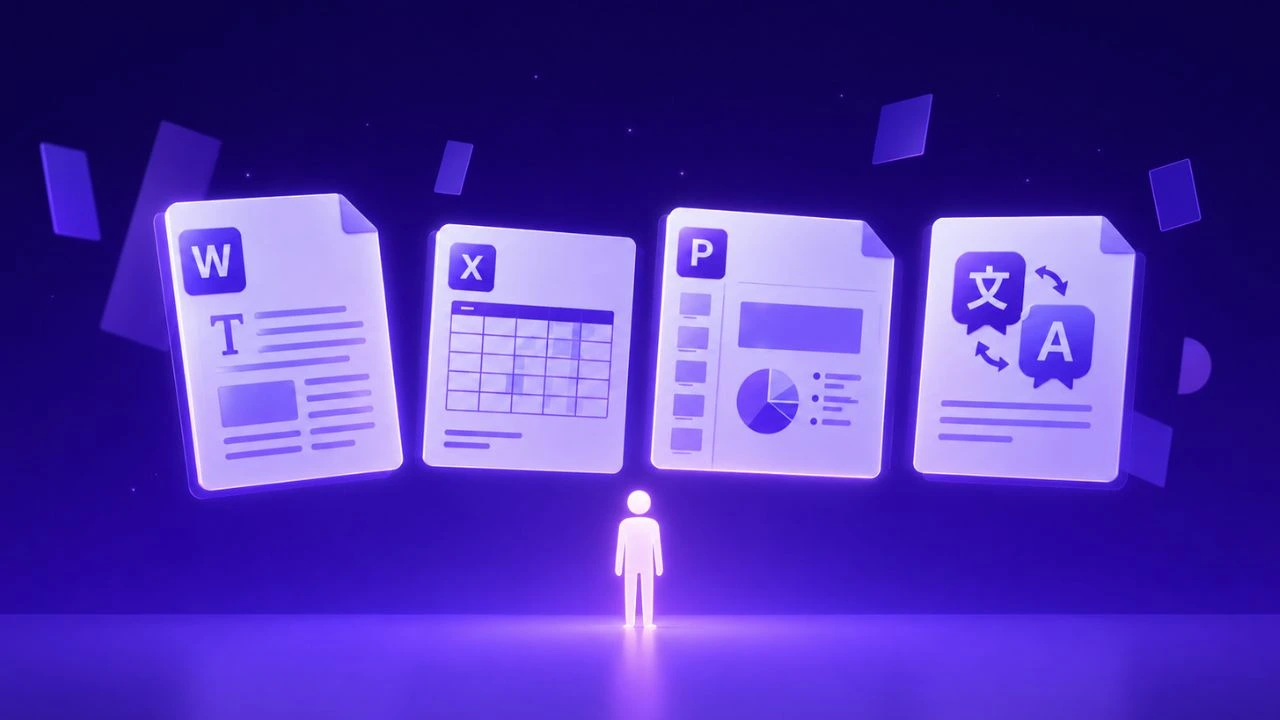
How to Extract Data from a PDF into Excel Automatically
If you're copying numbers from PDFs into Excel by hand, you already know it's slow. What you might not know is how expensive it actually is.
Manual data entry has an error rate of 1–4% per field . On a 100-field invoice, that's 1–4 errors — and 95% of those errors in financial services go undetected until they cause a downstream problem like a failed payment or audit exception. The average cost to fix a single data entry error in financial services: $53–98 .
There are five distinct methods for getting PDF data into Excel. Which one is right depends on your volume, document type, and technical capacity.
TL;DR
- Manual copy-paste: only viable for 1–2 documents. Beyond that, too slow and too error-prone
- Excel's built-in PDF importer (Data → Get Data → From PDF): free, fast for clean structured PDFs — fails on scanned files and complex layouts
- Adobe Acrobat Pro: better OCR, still manual steps per file
- Online converters (Smallpdf, iLovePDF): occasional use only
- Python (tabula-py, Camelot): full automation for developers — breaks when PDF layouts change
- AI document tools: handle scanned PDFs, variable layouts, and multi-language documents automatically
Why PDFs Are Hard to Extract Data From
PDFs were designed for sharing and printing — not for data analysis. Every element in a PDF is positioned using fixed coordinates on a static canvas. There's no underlying data structure the way a spreadsheet has rows and columns.
Three things make extraction harder:
Scanned PDFs (image-based files). A scanned PDF is a photograph of a page. There's no text to extract — only pixels. Extraction requires OCR first.
Variable layouts. Invoices, contracts, and reports from different suppliers rarely follow the same template. A tool trained on one layout breaks when the next document uses a different structure.
Multi-language documents. Data arriving from international suppliers may be in a different language. Extracting numbers and dates from a document you can't read introduces another layer of error risk.
Method 1: Excel Built-In PDF Importer (Free, No Setup)
Excel 365 and Excel 2019+ have a native PDF import feature. For clean, text-based PDFs with consistent table structures, it's the fastest free option available.
Step by step:
- Open Excel → Data tab
- Click Get Data → From File → From PDF
- Select your PDF file and click Open
- Excel opens a Navigator pane showing detected tables and pages
- Select the table → click Load to import directly, or Transform Data to open Power Query for cleanup
What works: Free, built into Microsoft 365. Works well on clean, consistently formatted PDFs — bank statements, simple invoices, government forms.
What doesn't: Fails completely on scanned PDFs. Struggles with merged cells, multi-column layouts, and tables spanning multiple pages. Layout variations between documents break the import logic. Only available to Microsoft 365 subscribers on Windows .
Best for: Occasional extraction of clean, text-based PDFs with consistent formatting.
Method 2: Adobe Acrobat Pro (Better OCR, Still Manual)
Adobe Acrobat Pro offers stronger PDF-to-Excel conversion than Excel's native importer, with OCR support for scanned files.
Step by step:
- Open the PDF in Adobe Acrobat Pro
- Go to File → Export To → Spreadsheet → Microsoft Excel Workbook
- If the PDF is scanned, Acrobat runs OCR automatically before converting
- Save the resulting .xlsx and clean up formatting in Excel
What works: Better OCR than Excel's built-in tool. Handles more complex layouts and scanned documents.
What doesn't: Requires a $19.99/month subscription. Manual process — one file at a time. Not designed for automation or batch processing.
Best for: Users already paying for Adobe Acrobat who need occasional PDF-to-Excel conversion with OCR support.
Method 3: Online PDF-to-Excel Converters (Free Tiers)
Browser-based tools like Smallpdf , iLovePDF , and Adobe's free online converter offer PDF-to-Excel conversion without software installation.
What works: No software installation. Free tiers for occasional use.
What doesn't: Free tiers have daily limits (Smallpdf: 2 tasks/day across all tools; iLovePDF: 1 task/day). Complex tables require significant cleanup. Not viable for volume processing.
Best for: Occasional personal use for simple, text-based PDFs.
Method 4: Python Automation (tabula-py, Camelot)
For developers or technically capable teams, Python libraries automate PDF extraction at scale — processing hundreds of files without manual steps.
import tabula
df = tabula.read_pdf("invoice.pdf", pages="all")[0]
df.to_excel("output.xlsx", index=False) What works: Full automation — no manual steps per file. Handles high volume. Free (open-source libraries).
What doesn't: Breaks when PDF layouts change — if a supplier sends a new invoice format, the script fails and requires a developer to fix. Requires Python knowledge. Scanned PDFs require adding an OCR library separately.
Best for: Development teams processing high volumes of PDFs with consistent layouts.
Method 5: AI Document Extraction Tools (Best for Complex and Variable PDFs)
AI-powered document extraction tools understand document context — recognizing that a table labeled "Invoice Total" should contain a number, regardless of where on the page that element appears.
This matters for real-world workflows where:
- PDFs come from multiple suppliers with different formats
- Documents are partially or fully scanned
- Tables have merged cells, subtotals, or irregular structures
- Documents are in a foreign language and require translation before the data can be used
**How Doctranslate.io Secretary works:**
- Upload your PDF (or batch of PDFs)
- Doctranslate.io reads the document structure — native PDF, scanned file, or foreign-language document
- Key data fields are extracted and mapped to your template
- Download the populated spreadsheet
For teams receiving invoices from international partners, Doctranslate.io Document Translation handles the translation step in the same pipeline — eliminating the need to run OCR, translate, and manually enter data across three separate tools.
What works: Handles variable layouts without breaking when document formats change. Built-in OCR for scanned files. Supports multi-language documents.
What doesn't: Paid tool — starts at $19.99/month after a free trial. For very simple, identical-format PDFs, Excel's built-in importer may be all you need.
Best for: Finance, operations, logistics, and import/export teams receiving documents from multiple sources in variable formats.
Method Comparison Table
| Method | Scanned PDFs | Variable layouts | Volume | Technical skill needed | Cost |
|---|---|---|---|---|---|
| Excel built-in (Power Query) | No | Poor | Low | None | Free (Microsoft 365) |
| Adobe Acrobat Pro | Yes | Moderate | Low (manual) | None | $19.99/month |
| Online converters | Limited | Poor | Low | None | Free (limited) |
| Python (tabula-py, Camelot) | With OCR added | Poor (breaks on change) | High | Developer required | Free (library) |
| [Doctranslate.io Secretary](https://doctranslate.io/office/secretary) | Yes (auto OCR) | Strong | Medium–High | None | Free trial; from $19.99/month |
Decision Framework
| Your situation | Best method |
|---|---|
| Clean, text-based PDF, same format every time, occasional use | Excel built-in |
| Already paying for Adobe, occasional extraction | Adobe Acrobat Pro |
| One-off personal use, simple PDF | Online converter |
| High volume, consistent format, developer available | Python |
| Scanned PDFs, variable formats, no developer | [Doctranslate.io Secretary](https://doctranslate.io/office/secretary) |
| Foreign-language PDFs that need translating before extraction | [Doctranslate.io Secretary](https://doctranslate.io/office/secretary) + [Document Translation](https://doctranslate.io/translation/document) |
The Real Cost of Not Automating
Office workers spend approximately 10% of their work time on manual data entry . McKinsey estimates that 42% of finance activities are fully automatable with current technology — with data entry being the most automatable task.
At the process level: the average cost to manually process a single invoice is $15.97 . Automated invoice processing costs $3.24 — a 79% reduction. For a team processing 500 invoices per month, that's a meaningful operational difference.
Common Problems and Fixes
Excel imports the table but columns are misaligned. PDF tables with merged cells confuse Excel's column detection. Fix: open the import in Power Query, manually promote the correct row as headers, and split or merge columns as needed.
Scanned PDF returns no data. Excel's built-in importer and most free converters can't read scanned PDFs. Fix: run OCR first using Adobe Acrobat, Google Drive (open PDF in Docs), or a tool with built-in OCR.
Numbers formatted as text. Currency symbols, thousand separators, and decimal conventions vary by country. Fix: use Find & Replace to remove currency symbols before converting to number format.
Python script breaks when PDF layout changes. The extraction coordinates are hardcoded to the previous format. Fix: update the script for each new format, or switch to a context-aware AI tool.
Foreign-language PDF — field labels are unreadable. Standard extraction tools pull the numbers, but field names in the foreign language are unrecognizable. Fix: translate the document first, then extract.
Frequently Asked Questions
Can Excel extract data from a scanned PDF? No. Excel's built-in PDF importer only works on text-based PDFs. Scanned PDFs are image files. You need OCR to extract text from them first. Tools with built-in OCR like Adobe Acrobat Pro handle this automatically.
What's the best free way to extract PDF data to Excel? Excel's built-in Data → Get Data → From PDF is the best free option for text-based PDFs with consistent formatting. For occasional use with simple PDFs, Smallpdf (2 tasks/day free) or iLovePDF (1 task/day free) also work.
Can I automate extracting data from multiple PDFs at once? Yes. Python with tabula-py or Camelot can process entire folders of PDFs in one script. AI extraction tools like Doctranslate.io Secretary support batch processing without requiring code.
Is it safe to upload business PDFs to online converters? Check the tool's data handling policy before uploading anything sensitive. For confidential business documents, financial records, or anything containing personally identifiable information, verify the tool's data retention and security policies first.
What to Do
For a few documents per week with consistent formats, Excel's built-in importer or a free online converter covers the need.
For dozens of PDFs with variable formats, scanned content, or foreign-language documents, the time spent manually fixing extraction errors typically costs more than a paid tool. Test on one real document from your actual workflow before committing.
Discussion
No comments yet